
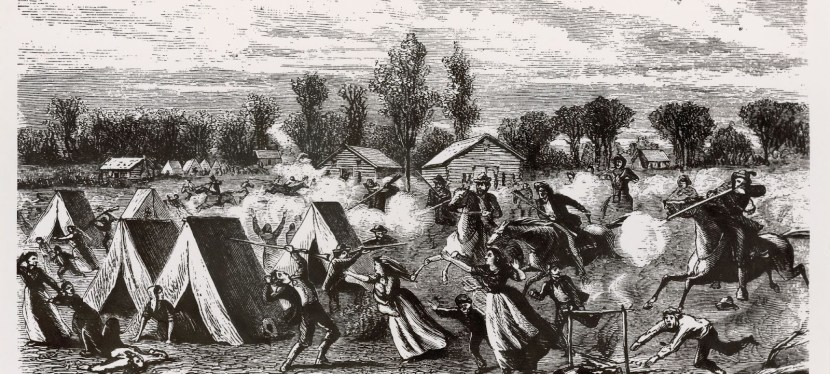
The history of The Church of Jesus Christ of Latter-day Saints (LDS Church) is marked by significant episodes of persecution from its founding in the early 19th century through its migration to the western United States. The persecution faced by early Mormons involved social ostracism, economic hardship, legal challenges, and violent mob actions, all of which played a pivotal role in shaping the church’s development and migration patterns. However, the antagonism did not end in the 1800s. Today, persecution of Mormons continues, but it takes more subtle forms, including a host of literature, which includes things like the CES Letter. A summary of CES Letter is that it is around 80 pages of arguments against the Mormon Church. There are thirteen sections and many more subsections in the document–the majority of which are arguments against the history of the church.
Joseph Smith founded the LDS Church in 1830 in upstate New York. The early converts faced immediate suspicion and hostility from their neighbors, primarily due to their unconventional religious beliefs, including the claim that Smith had translated the Book of Mormon from golden plates shown to him by an angel. This hostility led the Mormons to relocate to Kirtland, Ohio, where they hoped to establish a more stable community.
One of the most repeated arguments in the CES Letter is that Joseph Smith could not have translated all of the documents he claims to have translated, including the Book of Mormon. However, many of the CES Letter’s arguments misrepresent the source materials or don’t account for multiple interpretations of the evidence.
Kirtland became an important center for the church. In 1831, Joseph Smith received a revelation instructing church members to gather in Kirtland. This led to an influx of Mormons from various parts of the United States, significantly increasing the population and influence of the church in the area.
The rapid growth of the Mormon community in Kirtland created tensions with the local population. The Mormons’ religious beliefs and political influence often clashed with established residents’ norms and expectations. The key point of tension came when leaders of the church established the Kirtland Safety Society, a banking institution. The failure of this institution in 1837 led to financial ruin for many members and further inflamed anti-Mormon sentiment.
Tied to this is another argument about Joseph Smith and the CES Letter. The Mormon Church and its members believe that the leaders of their church are called by God as prophets who receive revelation. However, sometimes the leaders of the church have made mistakes like Joseph Smith opening a bank that failed. Other prophets have taught obscure or discriminating doctrines, which have been disavowed by later church leaders. The CES Letter argues that this negates the church’s claim that prophets receive revelation.
Anti-Mormon mobs targeted church leaders and members, often resorting to intimidation and physical assaults. Joseph Smith and other leaders were frequently subjected to legal harassment, facing numerous lawsuits and arrests based on trumped-up charges. One of the most notable incidents of persecution occurred in 1832 when Joseph Smith and Sidney Rigdon were dragged from their homes by a mob, beaten, tarred, and feathered. This brutal attack exemplified the extreme measures some opponents were willing to take to intimidate and expel the Mormon community from Ohio.
The economic instability, combined with ongoing persecution, as well as a revelation that Missouri, specifically Jackson County, was designated as Zion, a New Jerusalem led Joseph Smith and the church leadership to relocate to Missouri in 1838. They sought a safer and more stable environment for their followers. Unfortunately, the influx of Mormon settlers quickly led to conflict with the existing residents, similar to that of Kirtland.
In 1833, these tensions exploded into violence, with anti-Mormon mobs attacking Mormon settlements, destroying property, and expelling Mormons from Jackson County. The violence and unrest continued in Missouri, leading to the infamous 1838 Mormon War. Governor Lilburn Boggs issued the “Extermination Order,” which declared that Mormons must be “exterminated or driven from the state.” This led to the Haun’s Mill massacre, where 17 Mormons were killed by a mob.

Following their expulsion from Missouri, the Mormons found a temporary haven in Illinois, where they established the city of Nauvoo. Nauvoo quickly grew into one of the largest cities in Illinois and became a significant center for the church. However, as Nauvoo’s influence grew, so did the animosity of surrounding communities.
Joseph Smith’s increasing political and military power, combined with controversial practices like plural marriage, fueled anti-Mormon sentiment. In 1844, tensions reached a boiling point when Smith ordered the destruction of a printing press that had published intense criticism on his practices, including plural marriage. This act led to his arrest, and on June 27, 1844, Joseph Smith and his brother Hyrum were murdered by a mob while imprisoned in Carthage, Illinois.
The Mormon CES Letter also addresses the topic of plural marriage. The author of the CES Letter takes issue with the fact that as a member of the Mormon Church, he had never learned that Joseph Smith practiced polygamy. He also outlines details of polygamy that bother him personally. For example, some women who were sealed to Joseph Smith were married to other men (polyandry). They never lived with Smith or had a sexual relationship with him after their marriages, but continued to live with their previous husbands.
After Joseph Smith’s death, Brigham Young assumed leadership of the LDS Church and led the Mormon migration westward to the Salt Lake Valley in present-day Utah. This move was driven by the need to find a place where Mormons could practice their faith without persecution. The arduous journey, known as the Mormon Pioneer Trek, involved thousands of Mormons traveling by wagon and handcart across the Great Plains and Rocky Mountains.
In Utah, the Mormons hoped to establish a theocratic state, Deseret, under their own control. However, even in this remote location, they faced challenges from the federal government, particularly over the practice of plural marriage. The U.S. government passed a series of laws in the late 19th century aimed at curbing polygamy, leading to further legal and social pressures on the Mormon community.
The persecution of Mormons throughout the 19th century was characterized by a series of forced migrations, violent confrontations, and legal challenges. These experiences of hardship and resilience significantly shaped the identity and cohesion of the LDS Church. Today, persecution does not take such violent forms but often takes the form of the written word in such documents as the CES Letter. Despite the intense opposition they faced, Mormons were able to establish a strong, enduring community that continues to thrive today.

 Mom on the go in Holy Toledo